Consistently controllable monitoring as the foundation for AI-powered operations.
Challenge
Reliable monitoring becomes a challenge when change is the norm.
With every generation of technology, the path from idea to running system has become shorter. Automated server provisioning, the cloud with flexibly scalable resources and permanently integrated SaaS services, and most recently AI-assisted development mean that applications are created and changed faster and faster.
For operations, this means that the number of applications, services, and monitored objects is growing, changes are becoming more frequent, and dependencies denser. Monitoring and observability configurations must be updated continuously, while alerting structures that have grown over time become increasingly complex. The result is false alarms, high operational effort, and a lack of transparency regarding monitoring, routing, and responsibility. Individual teams can hardly keep track of the full picture anymore.
This is also reflected in the market: organizations use several monitoring and observability technologies in parallel, while complexity, missing context, and the effort required to handle alerts rank among the main burdens in operations. What matters, therefore, is not simply capturing more data. The key is to classify relevant events across systems, determine responsibilities, and trigger the right handling path.
This is where Adaptive Monitoring comes in, with an end-to-end operating framework for monitoring and observability. Reusable monitoring packages, automated provisioning, and controlled self-service reduce manual one-off solutions, establish clear responsibilities, and lay the foundation for AI-powered operations.
Relevance
Why this matters now
Adaptive Monitoring is particularly relevant when
hybrid IT landscapes need to be monitored consistently across cloud and on-premises environments,
monitoring configurations and operational processes that have grown over time need to be simplified, made reusable, and automated,
alert floods, operational data from different systems, and unclear responsibilities make it difficult to handle critical events,
existing monitoring and observability systems need to be integrated into a unified operating model and made available through controlled self-service,
operations processes are to be extended step by step with AI-powered analysis, correlation, and specialized agents, which requires a controllable operational foundation.
Approach
System & Structure of the Approach
Adaptive Monitoring makes proven monitoring configurations reusable and provisions them automatically for different applications and environments. Recurring requirements therefore no longer have to be implemented from scratch for every use case. Within defined guardrails, monitoring packages can be adapted to the respective operational context.
IT service owners and technical teams, for example from application operations, infrastructure, cloud, and DevOps, manage monitoring, alerting paths, and maintenance windows without needing to know the specifics of individual monitoring systems. Adaptive Monitoring is therefore not a single monitoring tool, but an architecture-driven operating framework built on a cloud-native Microsoft Azure platform.
Core building blocks:
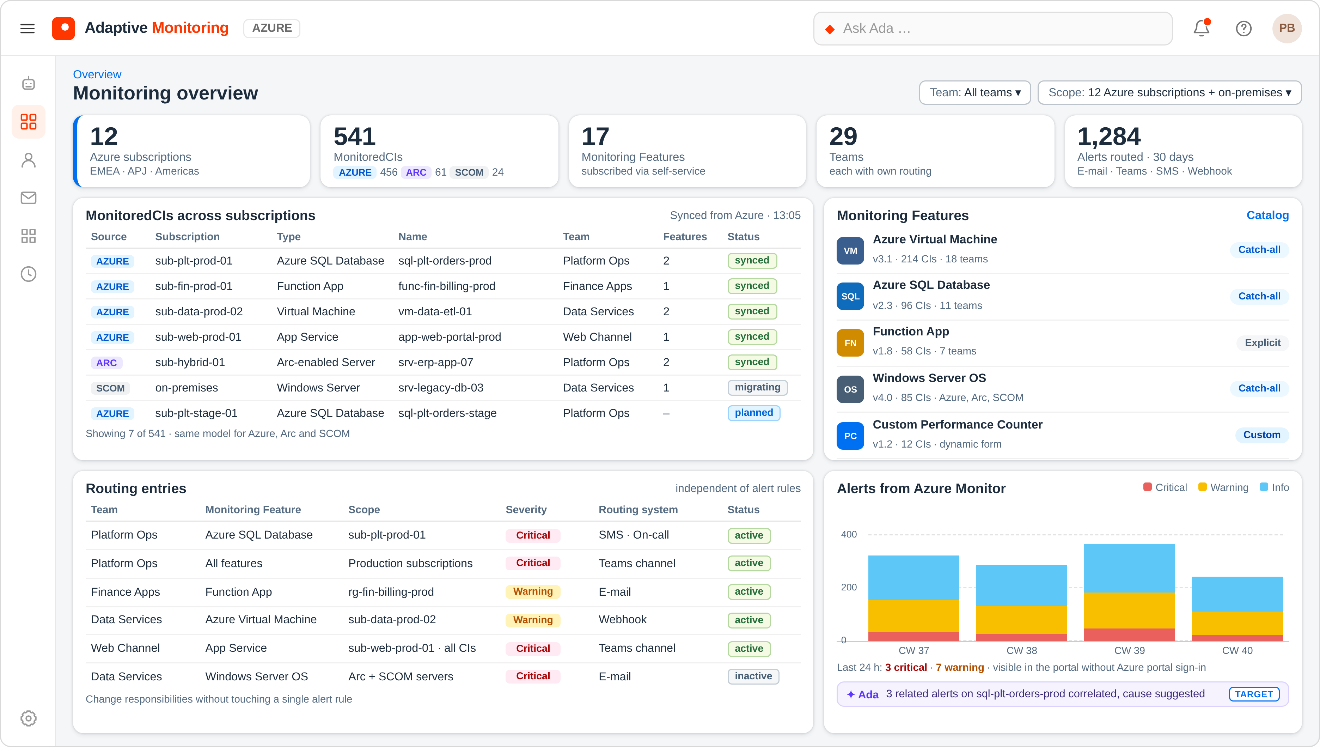
Subscribable monitoring packages Proven monitoring rules in transparent, versioned units. Teams subscribe to suitable packages and adapt them to their IT services via self-service within defined guardrails. Depending on the activation model, monitoring is active automatically, enabled selectively for specific IT objects, or fully configured by the user.
Separation of monitoring and routing What is monitored can be controlled independently of who is notified and which handling process is triggered. Events can be routed via email, SMS, collaboration channels, and webhooks, as well as to ticketing and incident management systems or specialized AI agents.
Automated provisioning Configuration, activation, and maintenance are largely automated. Declarative, versioned specifications are rolled out repeatably to the target environments. New monitoring requirements and routing targets can thus be implemented faster.
Controlled self-service IT service owners manage monitoring packages, alerting paths, and maintenance windows within defined guardrails. No specialist knowledge of the connected monitoring system is required.
Consistent normalization Technical identifiers from different source systems are converted into a consistent, understandable structure. As a result, monitored objects remain uniquely identifiable and usable via self-service.
Alert consolidation and governance Related events are filtered, correlated, and grouped into actionable cases based on defined criteria. This allows relevant events to stand out from the alert noise and gives them the context they need. Configurations, routing rules, changes, and responsibilities remain documented and clearly attributable.
Central alert management Alerts from different environments and connected monitoring systems are consolidated in a central workspace, where cases can be viewed, processed, and closed. Status changes are synchronized with the source systems.
Dashboarding and reporting Operational dashboards and reports provide transparency into alerts, routings, processing status, and the availability of monitored IT services. They support the evaluation of agreed service objectives and SLAs. Specialized reporting tools can be connected for more advanced analyses.
Integration An API-first approach provides functions and operational data via standardized interfaces. Existing monitoring and observability systems and additional automation components can be connected in a controlled way, without tying the operating model to a single product or having to completely replace existing tools.
Together, these building blocks link technical signals to monitored objects, IT services, responsibilities, and defined handling paths in a shared operational context.
AI-Powered Operations
The target architecture extends the proven operating model step by step with AI-powered operations, from assistive analysis and correlation toward agentic, orchestrated workflows. Structured operational data and defined configurations form the basis for combining AI-driven assessments with reliable interfaces, rules, and automations into controlled operational workflows.
Stage 1: Assistance and analysis An assistive agent supports people with individual tasks in natural language. Humans remain in control of the workflow and decide on next steps:
analyze alert and operational data, create evaluations and recommendations for action
prepare and review monitoring and routing configurations
correlate related events and identify possible causes of incidents
support recurring operational tasks
Stage 2: Agentic handling of the entire incident lifecycle The entire incident lifecycle, from detection to resolution, is orchestrated as one continuous workflow. Specialized agents take on clearly defined roles:
Detect: consolidate signals from connected source systems and capture anomalous patterns as related cases
Analyze: determine affected services, resources, dependencies, and impacts, narrow down causes, assign responsibilities
Orchestrate: determine the appropriate handling path and hand over the enriched case to a team, a ticketing system, or an agent
Resolve: execute and verify approved remediation actions automatically. If successful, the case is closed; otherwise, it is escalated to a human. This enables controlled self-healing scenarios.
Improve: document history, decisions, and outcomes and make them available for future cases
This requires clearly defined configurations, assigned responsibilities, and traceable decisions.
Governance by design Both stages are subject to defined controls. Each agent can be activated individually and restricted to specific systems, monitoring packages, or areas. Roles, permissions, and approval levels determine whether actions are prepared, executed after confirmation, or carried out autonomously within pre-approved guardrails. Interventions, decisions, rationale, and results remain transparently documented. Human responsibility is preserved.
Outcome
Structural added value for companies
Adaptive Monitoring enables organizations to achieve:
unified monitoring models and faster integration of new applications, resources, and services
less manual configuration and operational effort
less alert noise and higher relevance of the remaining events
clear responsibilities, traceable processes, and controlled self-service
integration of existing monitoring and observability systems
step-by-step expansion with automation and AI capabilities
Monitoring thus evolves from a collection of individual rules into a transparent, consistently controllable, and continuously evolving operating model.
Proven in Practice
The underlying operating model has been in productive use at PlanB. since 2015 and has been scaled for complex enterprise environments. Reusable monitoring packages, automated provisioning, controlled self-service, and the separation of monitoring and routing have proven themselves in day-to-day operations. The AI capabilities described here extend this foundation step by step.
In production, the model covers 25 teams or customer environments. In one connected monitoring system, around 4,000 IT objects and more than 100,000 associated technical components are monitored. In October 2025, 28 reusable monitoring packages controlled a total of 3,500 routings for open and closed alerts.
The following effects were achieved in productive use:
up to 75% less provisioning effort
up to 90% shorter provisioning times
up to 60% less operational effort
Contact
Would you like to explore this topic further or discuss a specific question? In a brief conversation, we can address your concerns, clarify the context, and suggest practical next steps – with no obligation.