
Compiled AI

Deterministic AI-based process execution
Challenge

There is a fundamental tension between the variable nature of AI and the requirements of stable business processes.

Stable execution of AI in enterprise processes

Reliable and reproducible execution of AI-based processes using Compiled AI

AI systems operate probabilistically and evaluate situations differently with each execution. This capability makes them powerful, as they can adapt flexibly to varying contexts. At the same time, this behavior leads to results that are not stable and may differ even when inputs are identical.

In many use cases, this characteristic is beneficial. However, in structured business processes, it creates a conflict. Processes must function reliably and be repeatable. They require stable workflows and traceable outcomes.

When AI is directly involved in execution, process behavior changes with each iteration. Results vary and workflows become difficult to control. The challenge therefore lies less in the capabilities of AI itself and more in how and where it is applied within the process.
Relevance

Why this matters now

As AI is increasingly integrated into operational workflows, the demands for stability, traceability, and scalability rise. Processes must be reproducible and reliably operate within existing system landscapes.

Probabilistic decision-making at runtime complicates these requirements. Processes become difficult to manage and cannot be executed consistently across multiple steps. As a result, the use of AI often remains limited to supporting roles.

The ability to transform AI into stable and deterministic execution thus becomes a key prerequisite for integrating it into operational processes and scaling its use across the enterprise.

Approach

System & Structure of the Approach

The approach is to deliberately shift how AI is used within processes.

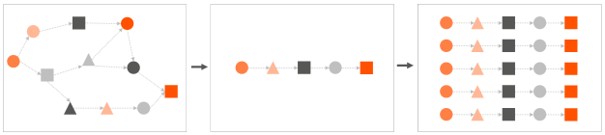
AI is used to define workflows and derive decision logic. This logic is then transformed into a fixed and executable structure. Execution no longer relies on variable decisions at runtime, but instead follows a stable, reproducible, and deterministic process.

This creates a clear separation between the derivation of a process and its operational execution. This approach follows the principle of Compiled AI, where an AI-based plan is transformed into a validated and consistently executable workflow.

From flexible, AI-based logic, a structured process is created that enables deterministic and reproducible execution.

For practical implementation, the INXM Orchestrator serves as the central foundation. In combination with the implementation by PlanB., the resulting processes are designed, integrated, and operated within the enterprise context.

This includes transforming AI-derived logic into robust process models, integrating them into existing applications and data flows, and embedding them into stable and traceable execution flows. This creates a reliable foundation that ensures execution, integration, and traceability over time.

It also covers the establishment of a stable technical and organizational foundation, as well as the ongoing operation and continuous improvement of these processes in production environments.

Outcome

Structural added value for companies

By separating AI-based decision logic from stable execution, a robust approach for operational AI emerges.

Processes behave consistently and produce identical results for identical inputs. Workflows become reproducible and can be reliably integrated into existing systems. Decisions are traceable, verifiable, and auditable.

This establishes the foundation for moving AI beyond isolated use cases into the actual execution of business processes. Applications evolve from isolated outputs into stable and scalable workflows that operate reliably in production environments.

The value lies in the structural transformation of process logic. AI is no longer used as a variable component in execution, but as the foundation for consistent, deterministic, and continuously executable processes.

Implementation is carried out by specialized teams