
Sovereignty for AI

From concept to control. Sovereignty is made actionable through architecture.
Challenge

Remain capable of action as technologies, platforms, and providers continuously evolve.

For many organizations today, sovereignty is no longer an unfamiliar topic. Yet, in practice, it often remains abstract.

Technology decisions are made, platforms are introduced, and AI initiatives are scaled. At the same time, new dependencies emerge. These involve vendors, operating models, and legal frameworks that are difficult to change later on.

This shifts the core challenge. It is no longer just about using new technologies, but about designing systems in a way that ensures lasting control over data, operations, and decision-making.
Relevance

Why this matters now

Sovereignty thus becomes a strategic management task.

The more AI is integrated into business-critical processes, the more directly architecture and technology decisions influence a company's ability to innovate, its speed, and its resilience.

In this context, several dimensions interlock. These include control over data, control over operations, and compliance with legal frameworks. However, these aspects cannot be viewed in isolation. They only become effective when implemented in a structured and consistent manner.

Sovereignty describes exactly this capability. Companies retain their ability to act because they can continue to develop and adapt their systems even under changing conditions.

Approach

System & Structure of the Approach

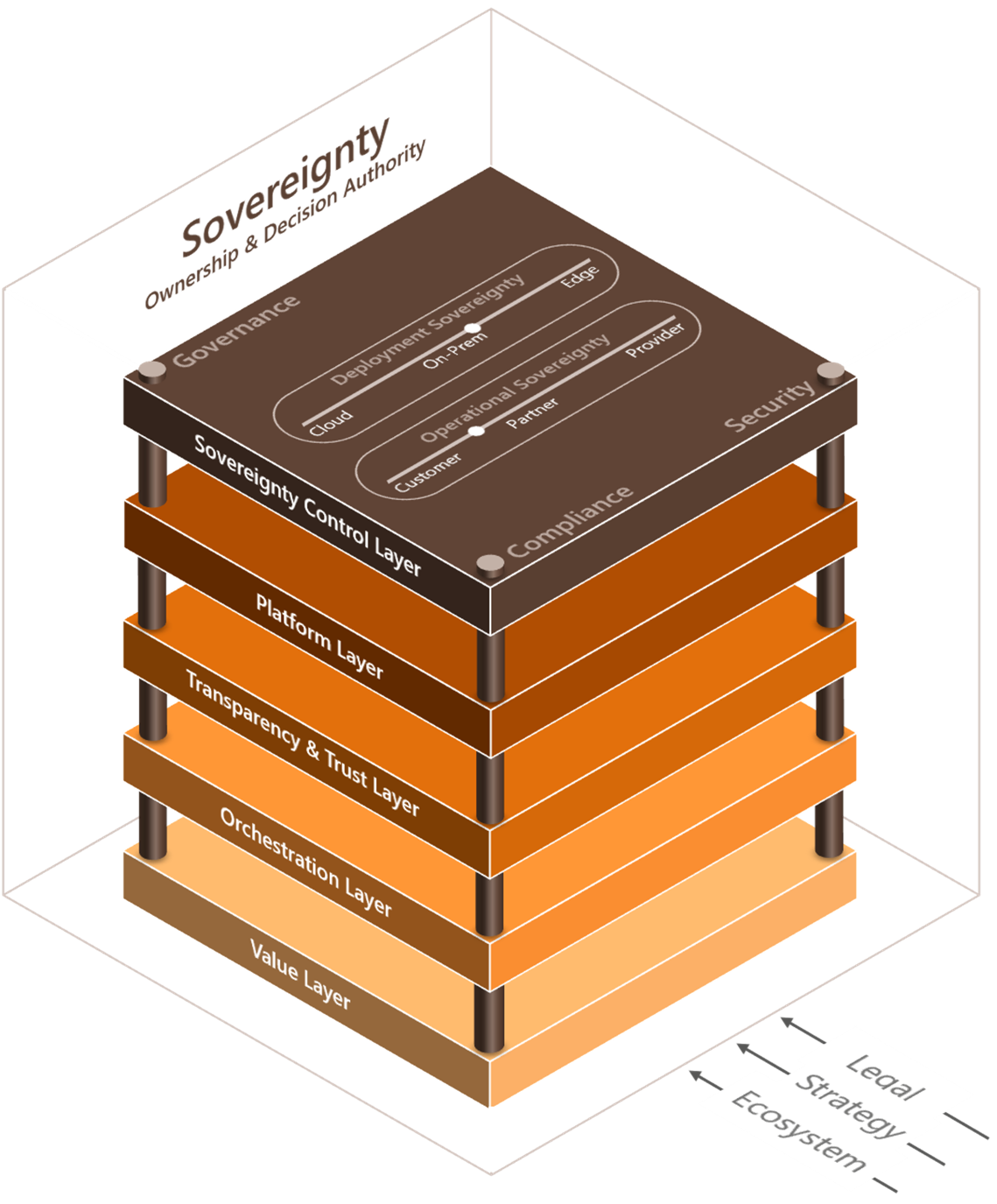
We do not view sovereignty as a single measure, but as an interplay of strategy, governance, and architecture.

Our approach translates these requirements into clear decision-making models and an actionable architectural structure.

  • Strategic alignment
    We analyze existing dependencies and categorize regulatory requirements. This results in a clear target vision for the company's sovereignty.
  • Translation into governance models
    Based on this target vision, governance structures, responsibilities, and decision-making logic are defined. Compliance is not viewed as an isolated goal, but as part of a controllable overall system. Sovereignty describes the goal, governance the implementation, and compliance the necessary accountability.
  • Derivation of architectural principles
    The objectives are translated into concrete architectural principles. Systems are built so that data, models, and applications remain decoupled. This creates interchangeability. Vendors can be switched, deployment models adjusted, and solutions further developed without destabilizing the overall system. Different operating models such as cloud, on-premises, or hybrid scenarios are also purposefully integrated and incorporated into a consistent structure.
  • Anchoring throughout the entire AI lifecycle
    Sovereignty is integrated across all phases. It shapes design decisions, development processes, and subsequent operations. Governance, security, and compliance interlock to ensure transparency, control, and traceability. This creates not an isolated concept, but an end-to-end system that functions across all levels.
Architecture is the vehicle for AI sovereignty: It structures control across all layers and, through governance, security, and compliance, ensures systems remain operational under external influences.
Outcome

Structural added value for companies

A sovereign approach creates sustainable advantages that extend far beyond individual projects.

  • Adaptability
    Systems can be flexibly developed and adapted to meet new requirements
  • Controllability
    Companies retain control over data, models, platforms, and operational processes
  • Transparency
    Dependencies become visible and can be actively managed
  • Resilience
    Architectures remain stable, even when individual components are replaced or modified

Sovereignty thus ensures long-term freedom of choice and reduces structural dependencies.