
Agentic AI marks a fundamental shift:Artificial intelligence no longer just provides ad-hoc support; instead, it independently takes on tasks, coordinates processes, and prepares or executes decisions.This shifts AI's role within the company – from a reactive tool to an active component of value creation.The Agentic Economy describes precisely this transition: the moment when autonomy, responsibility, and governability must be rethought.
Imagine this: It’s 3:00 a.m., and a digital AI agent spots a looming supply-chain delay. While you sleep, the agent has already contacted backup suppliers, rerouted logistics, and averted a stockout – your operations continue seamlessly without human intervention. Scenarios like this exemplify the Agentic Economy, where autonomous AI agents act as digital colleagues capable of reasoning, learning, and taking action at scale. These agents work alongside humans (or sometimes independently), handling tasks from routine customer requests to complex strategic planning. For the C-suite, this isn’t science fiction – it’s happening now. As MIT’s Sinan Aral puts it, “The agentic AI age is already here. We have agents deployed at scale in the economy to perform all kinds of tasks.”
The rise of agentic AI signifies more than just another tech trend. It marks a fundamental shift in how value is created and who (or what) creates it. Machines can now perform cognitive work once reserved for humans, upending traditional constraints of size and resources. Small startups can suddenly operate with the reach and efficiency of large enterprises, while global companies can move with the agility of lean disruptors. And it’s not just about efficiency—new business models are emerging as AI agents become products and services in their own right (think Agent-as-a-Service). At the same time, the ability to quickly spin up “disposable” software solutions on demand is accelerating innovation cycles like never before. The following key insights offer a high-level view of this transformation:
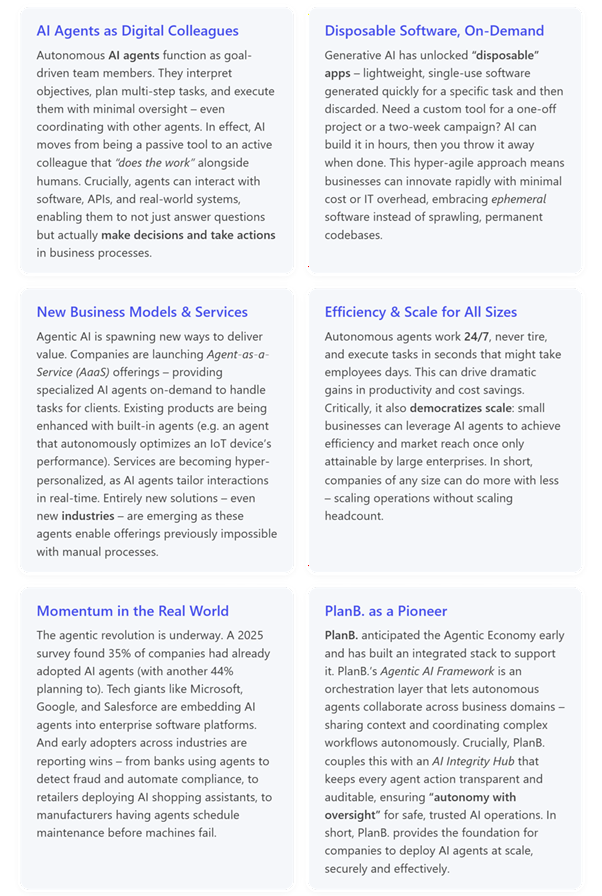
Agentic AI promises significant opportunities – from efficiency gains and new revenue streams to a more level competitive playing field – but it also raises new challenges in areas like integration, governance, and talent. Below, we delve into what the Agentic Economy means for businesses, the major opportunities it offers (and how those apply to organizations of all sizes), and the key challenges executives need to navigate. We’ll illustrate these points with case studies of companies already embracing agentic principles. Finally, we’ll see how PlanB. is uniquely positioned to help enterprises harness this technology, with a brief look at its approach to orchestrating AI agents responsibly.
At its core, the Agentic Economy is a business environment where AI agents – software programs endowed with autonomy – participate in economic activities as if they were “digital workers” or intermediaries. In practical terms, that means AI systems not only make recommendations or predictions; they can take action to execute multi-step tasks and drive outcomes in the business. This goes beyond the chatbots or RPA scripts of yesterday. Agentic AI systems can dynamically integrate with apps, APIs, and data sources, enabling them to, say, draft and send emails, negotiate contracts, monitor inventory, or even control physical devices, all on their own (within set guardrails).
Several characteristics define agentic AI:
In essence, agentic AI is moving us from software-as-tools to software-as-colleagues. As Salesforce CEO Marc Benioff describes, he now works “with a colleague who never sleeps, never takes vacations, and has read more than I could in 100 lifetimes” – namely, an AI agent that evaluates competitors, refines strategy documents, and reveals blind spots for him on demand. This new class of AI doesn’t just assist humans; it increasingly augments or even replaces the human role in certain tasks.
It’s important to note that agentic AI isn’t an all-or-nothing proposition. Most organizations will start with semi-autonomous agents that handle well-bounded tasks under human supervision. Over time, as confidence and capabilities grow, agents can be given more freedom and broader responsibilities. For example, an e-commerce company might begin with an AI agent that autonomously adjusts prices within a defined range; later, that same agent (or a more advanced version) might manage the entire supply reordering process, only notifying humans of exceptions.
Crucially, the Agentic Economy is not limited to tech giants or specific industries. Thanks to cloud-based AI platforms and decreasing costs, the barrier to entry is falling. As Nvidia’s CEO Jensen Huang noted in early 2025, enterprise AI agents represent a “multi-trillion-dollar opportunity” across industries from medicine to finance to manufacturing. And a study by MIT/Boston Consulting Group found that by 2023, 35% of surveyed companies had at least begun using AI agents, with another 44% planning to do so soon. In other words, the majority of companies are racing to adopt this technology. From lean startups to established market leaders, there’s broad recognition that autonomous agents will play a key role in the next era of business. For the C-suite, the mandate is clear: understand what agentic AI can do for your business model, or risk being left behind in the wake of those who do.
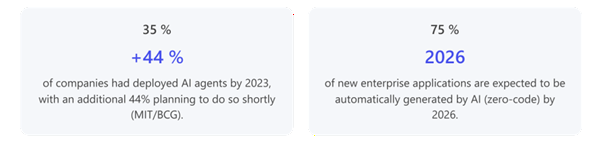
Adoption is accelerating. Left, an MIT/BCG survey shows that only a third of companies were using AI agents by 2023, but many more are close behind. Right, by 2026 an estimated 75% of new enterprise apps will be created without human programmers – a testament to AI’s growing capability to generate software (Gartner projection). In short, we’re rapidly moving toward a world where AI agents are ubiquitous in business.
With the groundwork laid for what agentic AI is, let’s turn to the potential upsides and downsides for companies embracing this paradigm.
For organizations willing to embrace the Agentic Economy, the benefits can be substantial. Here are some of the most significant opportunities that autonomous AI agents offer – applicable not just to large enterprises, but indeed to companies of all sizes:
In sum, the Agentic Economy holds the promise of smarter, faster, cheaper operations and entirely new avenues for growth. Companies that effectively deploy AI agents can unlock major competitive advantages: lower costs, improved agility, and new customer experiences. Early movers often gain a head start that lets them set industry benchmarks. For instance, enterprises that master agentic AI now can accumulate proprietary data and refinement cycles (learning) that create network effects and high barriers to entry for others. It’s no wonder experts like Salesforce’s Benioff see this as “the most significant transformation of work in history,” with the potential to “usher in extraordinary economic growth and entrepreneurship”.
However, these opportunities come hand-in-hand with formidable challenges. The next section examines those hurdles and what leaders should do to address them.
Adopting autonomous AI agents is not as simple as flipping a switch. Integrating and governing agentic AI in an organization presents new challenges that span technology, people, and policy. C-level executives must be aware of these potential hurdles:
In evaluating agentic AI, leaders should balance its amazing capabilities with a clear-eyed view of these challenges. One useful approach is to start with pilot projects that target high-value, low-risk processes – this allows working out integration kinks, building employee confidence, and establishing governance guardrails on a small scale before wider rollout. Many companies have learned that success with AI agents comes from iteratively expanding their autonomy as trust grows and systems mature, rather than a big-bang deployment.
The bottom line is that the Agentic Economy can unlock immense value – if enterprises approach it thoughtfully. As MIT’s Sinan Aral advises, every organization should develop a strategy for deploying AI agents, but that must go hand-in-hand with systematic risk assessment and management. In the next section, we look at a couple of real-world examples where companies have started to realize the promise of agentic AI, while navigating these very opportunities and challenges.
To illustrate how the Agentic Economy is materializing in practice, let’s explore two cases – one from a global enterprise and another from a small, agile company. Each demonstrates core principles of agentic AI delivering value in the field.
PepsiCo, one of the world’s largest food and beverage companies, has embraced agentic AI to sharpen its retail execution. With thousands of products across myriad retail outlets, keeping shelves stocked and promotions optimized is a constant challenge. PepsiCo leveraged Salesforce’s “Agentforce” platform (as part of a pilot) to deploy AI agents that act as virtual sales and supply chain coordinators. These agents continuously track inventory levels in stores and analyze sales data, alerting teams to low-stock situations and even triggering reorders or promotional tweaks in real time. For instance, if an AI agent detects that a popular snack is selling out quickly in a region, it can prompt an immediate restock shipment and suggest a targeted promotion if appropriate.
After implementation, PepsiCo saw tangible improvements. The AI agents provided unprecedented visibility into store-level conditions, helping prevent out-of-stock incidents and ensuring promotional displays were always supplied. Human managers remained “in the driver’s seat” – they could oversee the agents’ suggestions via a dashboard – but much of the grunt work of data gathering and initial analysis was handled autonomously. This freed PepsiCo’s field teams to focus more on strategic retailer relationships and in-store execution quality. The company noted that by having agents coordinate these behind-the-scenes tasks, they strengthened retailer partnerships (since stores experienced fewer missing items) and could respond faster to regional sales trends. PepsiCo’s case exemplifies how even a large enterprise with complex operations can harness AI agents to become more nimble at the execution edge, achieving a blend of scale and agility that’s hard to get otherwise.
HappyRobot is a logistics startup with only a handful of employees. Yet, thanks to AI agents, it operates with a reach and efficiency that rivals companies many times its size. HappyRobot’s mission is to reimagine warehouse logistics, and from the outset, the founders built the company to be an “agentic enterprise.” They use a suite of AI agents to automate workflows that would normally require entire departments – everything from order intake, scheduling shipments, tracking deliveries, to customer service. For example, one agent integrates with customer emails and a web chatbot to handle common inquiries about shipments entirely on its own. Another agent dynamically optimizes delivery routes each morning in response to traffic and order changes, then dispatches instructions to third-party drivers. Yet another monitors all warehouse sensors and alerts a human only if anomalies or bottlenecks are detected.
The impact has been striking: HappyRobot has cut internal coordination time by half compared to industry norms, because agents automatically share data and updates across the organization. A task like consolidating orders and generating picking lists – which might take a team of planners hours – is done in minutes by an AI agent. Consequently, this tiny startup can service a large volume of shipments and provide fast, reliable logistics services that feel “big company” to customers. As Marc Benioff highlighted, “with just a handful of employees, [HappyRobot is] already operating with the reach once reserved for much larger organizations” by deploying these agents. In other words, AI leveled the playing field, allowing a startup to scale up quickly without a massive hiring spree. HappyRobot’s success also underlines how AI lowers barriers to entry – a small firm can enter a space dominated by giants and compete effectively by leveraging intelligent automation. The founders are now exploring offering some of their internally developed agents as a service to other companies, turning their capability into an additional revenue stream.
Across industries and company sizes, the message is clear: the Agentic Economy is arriving fast, and it stands to reward those who adapt – and penalize those who don’t. We are witnessing what Salesforce’s CEO calls “the most significant transformation of work in history”. In this new era, organizations that thoughtfully implement AI agents can achieve leaps in productivity, unlock new business models, and empower small teams to have massive impact. Those that delay risk falling behind more daring competitors who rapidly iterate and scale with the help of AI.
Yet success with agentic AI isn’t guaranteed or easy. It requires a strategic vision and the right partner. This is where PlanB. distinguishes itself. PlanB. has positioned itself as a pioneer in agentic AI enablement, developing the tools and practices to help companies ride this wave safely and effectively.
At the heart of PlanB.’s offering is its Reference AI Architecture, with the Agentic AI Framework as the orchestration engine. This framework transforms disparate AI capabilities into cohesive, goal-driven agents that can work together. For instance, PlanB.’s platform allows a sales forecasting agent, a manufacturing agent, and a supply chain agent to all share context and coordinate a plan – something a company would otherwise have to custom-build from scratch. By providing a modular, policy-driven mesh for agents, PlanB.’s framework ensures that AI agents aren’t siloed “point solutions” but integrated team players within an enterprise’s processes.
Just as importantly, PlanB. learned early that governance and oversight are paramount. Its AI Integrity Hub serves as a central command center to monitor all agent activities. Every action an agent takes is logged; every decision can be traced and audited. PlanB. incorporates configurable rules so that, for example, an agent handling financial transactions cannot exceed a certain amount without approval, or an agent drafting communications must adhere to compliance guidelines. This focus on “autonomy with oversight” means companies can embrace AI agents without losing control – a critical concern for executives. When an agent’s proposed action crosses a predefined threshold, PlanB.’s system automatically involves a human or seeks confirmation, blending automation with prudent human judgment.
Additionally, PlanB. emphasizes vertical integration of AI. As their thought leadership points out, many companies have experimented with automation in isolated pockets (horizontal use cases) only to hit a ceiling of shallow impact. Real transformation comes when AI is embedded deeply into core business workflows (vertical integration) – and that’s a complex endeavor requiring orchestration, context-sharing, and change management. PlanB.’s approach is holistic: the Secure AI Platform provides the infrastructure and governance backbone, the Integration Layer connects agents into the company’s data and systems, and the Agentic AI Framework orchestrates the agents’ activities. This layered architecture means PlanB. can guide clients to weave AI agents into the fabric of their business, rather than bolting on disconnected bots. The result is scalable, enterprise-grade AI: systems where “vertical integration meets horizontal scalability, without compromise” – exactly what organizations need to turn pilot projects into widespread operational excellence.
In summary, PlanB. is exceptionally well positioned to help shape the Agentic Economy for its clients. It combines a cutting-edge technical solution with a deep understanding of the governance, integration, and strategy aspects that determine success. For C-level leaders, partnering with a firm like PlanB. can accelerate the journey toward becoming an “agentic enterprise” – one where AI agents and human teams work in concert to achieve more than either could alone. PlanB.’s mantra captures this vision: “AI that doesn’t just think, it works.” In the Agentic Economy, that is the ultimate goal – AI that delivers tangible business outcomes, responsibly and at scale.
The Agentic Economy is ushering in a new age of possibility. Companies large and small can seize this moment to reinvent themselves, powered by autonomous AI capabilities. The path is not without challenges, but with prudent leadership and the right partners, businesses can navigate the risks and unlock transformative gains. As we stand at this inflection point, the question for every executive is: How will you leverage AI agents to shape the future of your enterprise? The choices made now will determine the winners in the next chapter of business – an era where agility, intelligence, and innovation define success. Embracing the Agentic Economy today is an investment in being among those winners tomorrow.