
Enterprise leaders have grown accustomed to the promise of artificial intelligence transforming business. Yet the sobering reality is that most AI initiatives do not make it past the pilot phase – an estimated three out of four enterprise AI projects never reach production. This points to a persistent “execution gap” between experimental lab successes and operational outcomes. As AI systems mature, the frontier of competitive advantage is shifting. We are entering an “Execution Era” of AI: one where value comes not from bigger models or clever demos, but from embedding AI into core operations with reliable, integrated execution.
Enterprise AI investments are at an all-time high, yet operational success remains elusive. In one MIT study, only 5% of corporate AI pilots delivered meaningful value in production. Another industry survey found that while 80% of Fortune 500 companies had dozens of AI projects in the proposal stage, only 18% had more than 20 models deployed in production. The vast majority of AI initiatives get stuck in proof-of-concept mode, failing to scale beyond the lab to enterprise-wide adoption. The consequences are sobering: wasted investments, frustrated stakeholders, and skepticism about AI’s business value.
Why do so many AI efforts stall? The causes are usually structural and operational – not just technical. Many enterprises have poured resources into models and prototypes without equal attention to integration, reliability, and ownership. Legacy IT landscapes remain highly fragmented: “every system speaks its own language” – the issue is “not a lack of intelligence, but a lack of reliable execution across all systems”. AI solutions often end up siloed or disconnected from the daily workflows and decisions they were meant to improve.
Project teams frequently underestimate the demands of moving from a one-off pilot to a continuous, mission-critical operation. A machine learning model that performs well in a controlled environment can falter when confronted with the variability, scale, and strict reliability needs of real business processes. For example, an autonomous AI agent might find a plausible solution path in one run, but a different path – or different output – in the next run, a degree of improvisation incompatible with critical processes that demand consistent results each time.
Even when AI models are configured to reduce randomness, their outputs can vary significantly between runs due to subtle changes in context or system state. This inherent non-determinism undermines trust and reliability. As one analysis noted, if each step in a large AI-driven process is only approximately 94% reliable, the probability of 1,000 consecutive error-free steps is just around 0.004%. In high-stakes operations, even a small chance of error compounding across many steps quickly becomes unacceptable.
Organizational factors are equally critical. Many AI projects launch without a clear business owner or integration strategy. Without an accountable executive process owner, AI initiatives drift or remain proofs of concept. If AI is not integrated into core enterprise systems and workflows, it stays peripheral – a novelty with limited impact. And if projects are pursued for hype rather than solving pressing operational problems, they risk turning into innovation theater with no tangible ROI.
In short, technology alone cannot bridge the gap; success requires aligning AI projects with real processes, systems, and accountabilities from day one.
Leading organizations are recognizing that the era of pure model-centric competition is passing. As advanced AI models become widely accessible and their performance converges, the source of advantage is shifting from what an AI can do to how effectively you can deploy it. In the emerging Execution Era, AI’s impact is measured not by demo wow-factor but by operational outcomes – faster decisions, streamlined processes, and measurable ROI.
This pivot requires redesigning operations, not just automating tasks. Today, AI is moving from delivering isolated outputs to driving real outcomes within business workflows. That transition changes the nature of value creation: when AI participates in live operations, pure model intelligence is no longer the bottleneck – orchestration, controls, and accountability are.
“The model era was about capability; the execution era is about responsibility. The question is no longer ‘What can the model do?’ – it is ‘Can our organization execute on it responsibly and at scale?’”
Executives and operational leaders must therefore focus on the foundations of execution: integration, reliability, and governance. AI cannot simply be a detached tool sitting on top of existing processes. Unless AI is deeply integrated into ERP, CRM, supply chain, and other core systems, it cannot influence decisions at the right level or deliver sustained value.
A disconnected AI introduces new failure points through fragmented data and broken process flows. True ROI only emerges when AI becomes part of the company’s operating system, not a bolt-on experiment. This requires rigorous upfront planning: mapping where AI should sit in decision chains, defining how it escalates or defers to humans, and building governance into the design of AI-powered processes from the start.
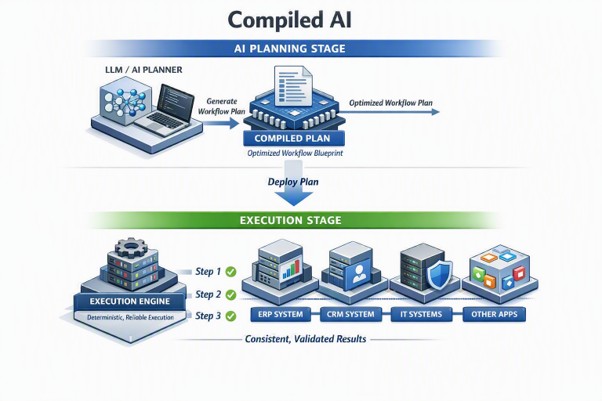
To realize this execution-centric vision, innovators are embracing a new technological paradigm sometimes called “Compiled AI.” This approach borrows a lesson from software engineering: just as compiled code offers stable, repeatable execution instead of interpretation at runtime, Compiled AI seeks to separate the creative, probabilistic “thinking” of AI from the deterministic “doing” of business operations.
In practical terms, an AI model such as an LLM is used once to generate an optimized workflow or decision logic, which is then converted into a fixed plan or executable code that runs reliably thereafter – without requiring the AI to improvise every time the process is executed.
This concept is now being validated in both research and practice. A recent study defines Compiled AI as a paradigm in which large language models generate executable code artifacts during a compilation phase, after which workflows execute deterministically without further model invocation. By deliberately restricting AI to a one-time planning phase, Compiled AI trades some real-time flexibility for major gains in predictability, auditability, cost efficiency, and security.
Crucially, every AI-derived plan goes through rigorous validation before deployment, including automated checks for security, correctness, and performance. This ensures that AI-generated logic meets enterprise-grade standards before entering production environments.
In effect, Compiled AI allows enterprises to treat AI-driven processes as trusted, repeatable software. The AI influences the business process only during the design phase, contributing creativity and learning to generate an optimal approach. Once compiled, the workflow is executed by conventional systems or workflow engines repeatedly and exactly, meeting the reliability requirements of core business operations.
This differs fundamentally from purely agent-based approaches that rely on a model to make decisions dynamically at runtime. Such approaches are more vulnerable to inconsistency and unpredictable outcomes. By contrast, the Compiled AI approach ensures deterministic outcomes for critical processes by positioning AI as a design partner rather than an uncontrolled runtime actor.
Bridging the gap between AI and operations requires cross-functional teams and new roles that combine technical expertise with deep business knowledge. Forward-thinking organizations are embedding AI specialists directly into business units or pairing them with dedicated process owners to ensure that solutions are designed with operational context, accountability, and measurable outcomes in mind.
These hybrid roles – often compared to forward-deployed engineers – bring together data science, software engineering, and domain expertise to drive both innovation and execution. By owning AI initiatives from design through measurable business impact, these teams ensure that AI is not only built, but also adopted and successfully integrated into day-to-day operations.
In the Execution Era, integration and orchestration technologies become strategic assets. Organizations increasingly establish process execution engines and intelligent orchestration platforms that connect AI into the broader enterprise landscape, spanning ERP, CRM, supply chain, and other mission-critical systems.
Modern orchestration frameworks operationalize the Compiled AI approach by using AI to design workflows and then transforming those workflows into production-ready code or execution logic. These platforms incorporate automated testing, monitoring, validation, and compliance checks as part of the deployment process.
The result is an environment in which AI-driven processes meet enterprise standards for reliability, security, and auditability, enabling organizations to scale automation confidently across thousands of decisions and operational activities.
Achieving what many industry leaders describe as “AI that finishes the work” requires a shift in leadership mindset. Executives must champion the integration of AI into business strategy and process design – not merely its experimental use.
Successful organizations increasingly place ownership of AI programs with business-oriented leaders such as Chief Operations Officers, Chief Digital Officers, or Chief Innovation Officers instead of isolating AI initiatives exclusively within IT or research teams.
At the same time, organizations establish clear governance frameworks that standardize how AI use cases are evaluated, developed, and scaled. These frameworks define metrics for monitoring both model performance and business impact, ensuring that AI initiatives remain aligned with organizational objectives.
Leaders also prioritize Responsible AI practices, ensuring that increasing levels of automation remain transparent, compliant, and aligned with corporate values and regulatory requirements. By emphasizing execution discipline and accountability for outcomes rather than technical novelty alone, organizations create the foundation for sustainable AI success.
The Execution Era represents the pragmatic maturation of enterprise AI. After years of experimentation and enthusiastic pilots, organizations are increasingly recognizing that the true value of AI emerges when it becomes part of operational reality.
This means shifting focus from generating isolated insights toward delivering consistent, repeatable business outcomes. By redesigning operating models, establishing robust integration frameworks, and leveraging concepts such as Compiled AI to achieve reliability at scale, organizations can move AI beyond the laboratory and into the heart of the enterprise.
In the long run, those who master execution rather than experimentation alone will capture AI’s greatest competitive advantages. The organizations that thrive in this new era will be the ones that treat AI not as a science project, but as a core component of how work gets done every day.