
Enterprise AI Reference Framework

Target architecture for scalable Enterprise AI.
Challenge

Scale, integrate, and operate AI systems securely, without architectural disruptions or loss of control.

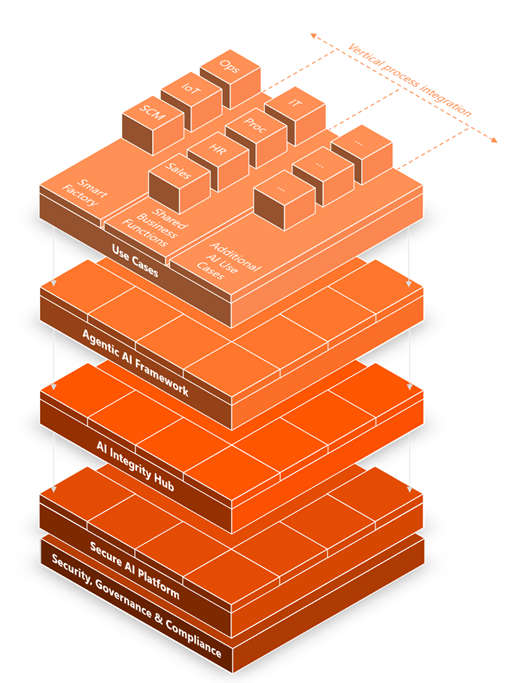
The Enterprise AI Reference Framework outlines the overarching vision for AI deployment within an enterprise. It defines how organizations can integrate AI systems into existing IT landscapes in a stable, secure, and scalable manner, while maintaining control over key architectural decisions.

Artificial intelligence is not viewed as an isolated application, but rather as a continuously operable enterprise capability with clear governability over data, models, and operating modes.

The focus is on how data, models, agentic systems, platforms, and existing core systems consistently interoperate.
The Reference Framework provides guidance, reduces complexity, and forms the basis for controlled scaling of AI within an enterprise context.

It thereby establishes the structural foundation for AI Sovereignty, which is the ability to continue developing AI in a controlled manner even under changing technological, regulatory, and operational conditions.
Relevance

Why this matters now

The Enterprise AI Reference Framework is particularly suitable for organizations that:

  • want to deploy AI enterprise-wide or across departments
  • need to consistently integrate multiple AI use cases
  • connect existing IT systems (ERP, CRM, specialized applications)
  • operate agentic or data-driven systems
  • want to architecturally secure scalability, security, and operations early on
  • want to maintain control over their data, models, and operating models even as complexity grows

It is suitable for complex enterprise environments with high requirements for stability, security, and reusability.

Approach

System & Structure of the Approach

The Enterprise AI Reference Framework forms the structural basis for controllable AI systems and defines core architectural principles and structural components for enterprise AI, including:

  • Vision & Architectural Principles
    Clear guardrails for the integration, scalability, and security of AI systems.
  • Platform and Infrastructure Layer
    Cloud, hybrid, and platform architectures as the foundation for AI workloads.
  • Data & AI Layer
    Models, data pipelines, agents, and lifecycle mechanisms.
  • Integration Layer
    Integration of existing enterprise systems and data sources.
  • Security & Identity by Design
    Identities, access controls, and protection mechanisms as an integral part of the architecture.

The architecture is deliberately designed for long-term control and adaptability.

  • Modular Design
    Extendable and adaptable without structural dependencies
  • Vendor-agnostic
    Free choice of technologies without vendor lock-in
  • Location-independent (Cloud, Edge, On-Prem)
    Deployment depending on regulatory and strategic requirements
  • Flexible Operating Models
    Choice between company-operated, partner-operated, or provider-managed solutions

The Reference Framework serves as a guidance and decision-making framework, rather than a rigid implementation pattern.

Outcome

Structural added value for companies

The Enterprise AI Reference Framework not only enables companies to create scalable AI landscapes but also lays the foundation for clear control over their AI architecture:

  • Consistent and scalable AI landscapes
  • Reduction of architecture and integration risks
  • Faster implementation of new AI use cases
  • Improved decision-making through clear objectives
  • Sustainable operability of AI systems

AI is thus not introduced in an isolated manner, but is strategically, structurally, and controllably embedded within the company.