
"Compliance is not strategy." This provocative mantra is echoing in boardrooms and CIO forums as companies grapple with the implications of AI and cloud adoption in 2026. For years, enterprises have focused on governance and compliance. Yet in a world of powerful cloud platforms and AI models, these are no longer enough. Sovereignty is emerging as the true strategic differentiator.
In many companies, compliance and governance have been treated as afterthoughts or necessary evils - boxes to check to satisfy regulations or avoid crises. The prevailing conversation often centers on "Are we compliant?" or "Do we have governance policies in place?". While important, these questions are often reactive and minimalistic. They aim at meeting requirements, not driving advantage.
Compliance answers "Are we allowed to do this?", and governance defines "How do we control this?". But focusing only on these keeps organizations in a defensive posture. Compliance is necessary, but it does not guarantee strategic success or resilience. Digital sovereignty has therefore become a board-level imperative - something to be built into strategy and architecture, not just documentation.
Why are governance- and compliance-centric approaches insufficient? Because they focus on minimum requirements rather than true autonomy and control. This creates risks:
In short: compliance is not a growth strategy. It is the cost of entry. What is missing is a focus on control and autonomy by design - digital sovereignty. Organizations must move from avoiding risk to actively controlling their digital destiny.
Sovereignty acts as the umbrella concept that encompasses and extends governance and compliance:
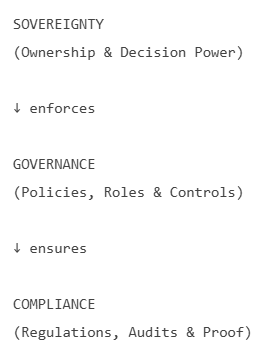
Sovereignty defines the "why" and "what". Governance defines the "how". Compliance defines the "must".
Sovereignty reframes governance and compliance as tools of strategy, not goals in themselves. Data residency alone is not enough. The critical question is: Who controls access, decisions and operations?
Sovereignty ensures that organizations remain in control. It connects governance and compliance into a coherent system and ensures independence, security and decision-making capability.
A sovereignty-first approach requires CIOs to make architecture and operational decisions that ensure control:
Sovereignty-minded CIOs treat architecture and operations as levers of control. They embed sovereignty into cloud design, AI platforms, identity systems and even contractual agreements.
Sovereignty changes not only decisions, but also how decisions are made:
The result is an organization that is both more resilient and more agile. By building sovereignty by design, companies can adapt faster to regulatory change and technological shifts.
Focusing only on compliance means playing not to lose - but it does not win the future. Leadership requires shifting from risk avoidance to owning your destiny.
Forward-looking organizations align compliance and governance under sovereignty - using them as instruments of strategy. Sovereignty becomes a design principle for control, trust and autonomy.
If you do not design for sovereignty, others will define it for you. In the era of AI and multi-cloud, control is the real strategy. Sovereignty is strategy.
The views expressed in this article are the author's professional opinion and strategic interpretation of current developments in digital sovereignty, enterprise AI, cloud computing, governance and compliance. This article is intended for informational and thought-leadership purposes only and does not constitute legal, regulatory, compliance, investment or professional advice. Organizations should obtain appropriate legal, regulatory and technical advice before making strategic or operational decisions.