Agentic AI markiert einen grundlegenden Wandel: Künstliche Intelligenz unterstützt nicht mehr nur situativ bei einzelnen Aufgaben, sondern übernimmt eigenständig Tätigkeiten, koordiniert Prozesse und bereitet Entscheidungen vor oder führt sie aus.
Dadurch verändert sich die Rolle von KI im Unternehmen – vom reaktiven Werkzeug hin zu einem aktiven Bestandteil der Wertschöpfung.
Die Agentic Economy beschreibt genau diesen Übergang: den Zeitpunkt, an dem Autonomie, Verantwortung und Steuerbarkeit neu gedacht werden müssen.
Stellen Sie sich Folgendes vor: Es ist 3:00 Uhr morgens, und ein digitaler KI-Agent erkennt eine drohende Verzögerung in der Lieferkette. Während Sie schlafen, hat der Agent bereits alternative Lieferanten kontaktiert, die Logistik umgeleitet und einen Warenengpass verhindert – Ihre Abläufe laufen nahtlos weiter, ohne menschliches Eingreifen. Szenarien wie dieses zeigen, was die Agentic Economy ausmacht: eine Wirtschaft, in der autonome KI-Agenten als digitale Kolleginnen und Kollegen agieren, die denken, lernen und in großem Maßstab handeln können. Diese Agenten arbeiten Seite an Seite mit Menschen oder teilweise auch eigenständig und übernehmen Aufgaben von einfachen Kundenanfragen bis hin zu komplexer strategischer Planung. Für die C-Suite ist das keine Science-Fiction mehr – es passiert bereits heute. Wie MIT-Professor Sinan Aral sagt: „Das Zeitalter der agentischen KI ist bereits da. Wir haben Agenten im großen Maßstab in der Wirtschaft im Einsatz, die unterschiedlichste Aufgaben übernehmen.“
Der Aufstieg agentischer KI ist mehr als nur ein weiterer Technologietrend. Er markiert einen grundlegenden Wandel darin, wie Wert geschaffen wird und wer oder was diesen Wert schafft. Maschinen können heute kognitive Arbeit übernehmen, die früher ausschließlich Menschen vorbehalten war, und stellen damit traditionelle Grenzen von Größe und Ressourcen infrage. Kleine Start-ups können plötzlich mit der Reichweite und Effizienz großer Unternehmen agieren, während globale Konzerne sich mit der Beweglichkeit schlanker Disruptoren bewegen können. Und es geht nicht nur um Effizienz: Es entstehen neue Geschäftsmodelle, weil KI-Agenten selbst zu Produkten und Services werden, etwa im Sinne von Agent-as-a-Service. Gleichzeitig beschleunigt die Fähigkeit, schnell „wegwerfbare“ Softwarelösungen nach Bedarf zu erzeugen, Innovationszyklen wie nie zuvor. Die folgenden Abschnitte geben einen übergeordneten Blick auf diese Transformation.
Agentische KI verspricht erhebliche Chancen – von Effizienzgewinnen und neuen Umsatzquellen bis hin zu faireren Wettbewerbsbedingungen –, bringt aber auch neue Herausforderungen in Bereichen wie Integration, Governance und Talent mit sich. Im Folgenden betrachten wir, was die Agentic Economy für Unternehmen bedeutet, welche wesentlichen Chancen sie bietet und wie diese für Organisationen jeder Größe relevant werden. Außerdem beleuchten wir zentrale Herausforderungen, die Führungskräfte bewältigen müssen. Anhand von Fallstudien zeigen wir, wie Unternehmen agentische Prinzipien bereits heute nutzen. Abschließend betrachten wir, wie PlanB. Unternehmen dabei unterstützen kann, diese Technologie verantwortungsvoll zu nutzen und KI-Agenten wirksam zu orchestrieren.
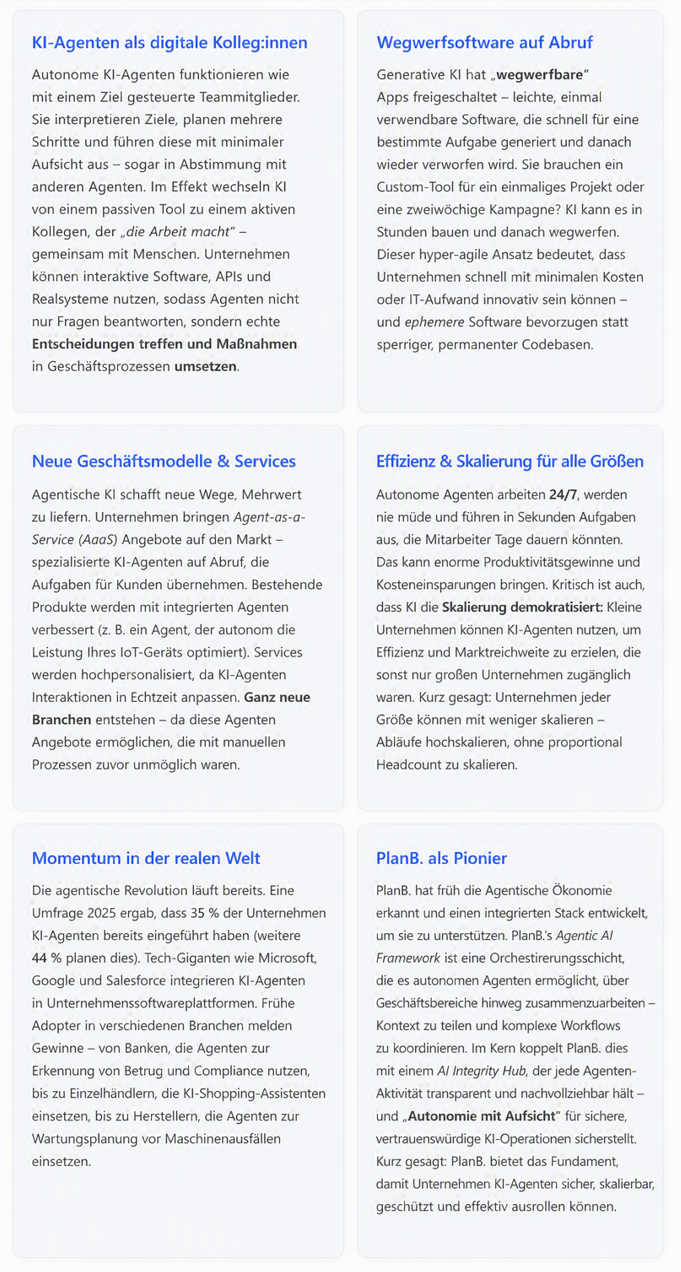
Im Kern beschreibt die Agentic Economy ein wirtschaftliches Umfeld, in dem KI-Agenten – also autonome Softwareprogramme – an wirtschaftlichen Aktivitäten teilnehmen, als wären sie „digitale Arbeitskräfte“ oder Vermittler. Praktisch bedeutet das: KI-Systeme geben nicht nur Empfehlungen oder Prognosen ab, sondern können handeln, um mehrstufige Aufgaben auszuführen und geschäftliche Ergebnisse zu erzielen. Das geht weit über Chatbots oder RPA-Skripte der Vergangenheit hinaus. Agentische KI-Systeme können sich dynamisch mit Anwendungen, APIs und Datenquellen verbinden und dadurch beispielsweise E-Mails entwerfen und versenden, Verträge verhandeln, Bestände überwachen oder sogar physische Geräte steuern – eigenständig und innerhalb definierter Leitplanken.
Mehrere Merkmale definieren agentische KI:
Im Kern bewegen wir uns mit agentischer KI von Software als Werkzeug hin zu Software als Kollegin oder Kollege. Salesforce-CEO Marc Benioff beschreibt etwa, dass er heute mit „einem Kollegen arbeitet, der nie schläft, nie Urlaub macht und mehr gelesen hat, als ich in 100 Leben lesen könnte“ – gemeint ist ein KI-Agent, der Wettbewerber bewertet, Strategiedokumente verbessert und auf Abruf blinde Flecken sichtbar macht. Diese neue Klasse von KI unterstützt Menschen nicht nur; sie erweitert zunehmend ihre Fähigkeiten oder ersetzt in bestimmten Aufgaben sogar menschliche Rollen.
Wichtig ist: Agentische KI ist keine Alles-oder-nichts-Entscheidung. Die meisten Organisationen werden mit teilautonomen Agenten beginnen, die klar abgegrenzte Aufgaben unter menschlicher Aufsicht übernehmen. Mit wachsendem Vertrauen und steigenden Fähigkeiten können Agenten schrittweise mehr Freiheit und Verantwortung erhalten. Ein E-Commerce-Unternehmen könnte beispielsweise mit einem KI-Agenten starten, der Preise innerhalb eines definierten Rahmens autonom anpasst. Später könnte derselbe Agent oder eine weiterentwickelte Version den gesamten Nachbestellprozess steuern und Menschen nur noch bei Ausnahmen informieren.
Entscheidend ist außerdem: Die Agentic Economy ist nicht auf Tech-Giganten oder bestimmte Branchen beschränkt. Dank cloudbasierter KI-Plattformen und sinkender Kosten sinken die Einstiegshürden. Nvidia-CEO Jensen Huang bezeichnete Enterprise-KI-Agenten Anfang 2025 als eine „Multi-Billionen-Dollar-Chance“ über Branchen hinweg, von Medizin über Finanzwesen bis hin zur Fertigung. Eine Studie von MIT und Boston Consulting Group ergab zudem, dass bis 2023 bereits 35 % der befragten Unternehmen zumindest begonnen hatten, KI-Agenten einzusetzen, während weitere 44 % dies zeitnah planten. Mit anderen Worten: Die Mehrheit der Unternehmen arbeitet daran, diese Technologie zu übernehmen. Vom schlanken Start-up bis zum etablierten Marktführer ist die Erkenntnis breit angekommen, dass autonome Agenten in der nächsten Ära des Geschäfts eine zentrale Rolle spielen werden. Für die C-Suite ist der Auftrag klar: Verstehen, was agentische KI für das eigene Geschäftsmodell leisten kann – oder riskieren, von denen überholt zu werden, die es tun.
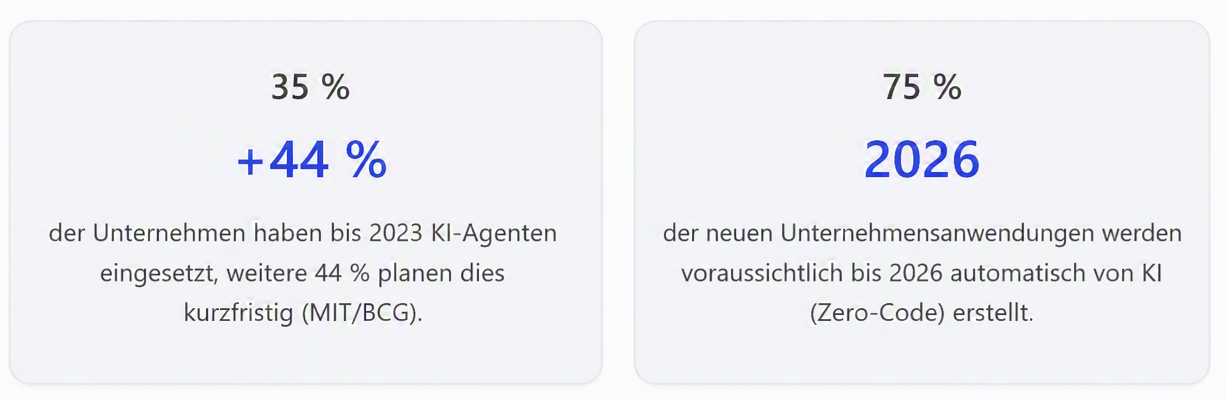
Die Einführung beschleunigt sich. Links zeigt eine MIT/BCG-Umfrage, dass bis 2023 nur rund ein Drittel der Unternehmen KI-Agenten einsetzte, viele weitere jedoch kurz davorstanden. Rechts wird prognostiziert, dass bis 2026 schätzungsweise 75 % neuer Unternehmensanwendungen ohne menschliche Programmierer erstellt werden – ein Beleg für die wachsende Fähigkeit von KI, Software zu generieren. Kurz gesagt: Wir bewegen uns rasch auf eine Welt zu, in der KI-Agenten im Geschäftsleben allgegenwärtig sind.
Nachdem die Grundlage dafür gelegt ist, was agentische KI bedeutet, wenden wir uns nun den möglichen Chancen und Risiken für Unternehmen zu, die dieses Paradigma übernehmen.
Für Organisationen, die bereit sind, die Agentic Economy aktiv zu nutzen, können die Vorteile erheblich sein. Die wichtigsten Chancen, die autonome KI-Agenten bieten, gelten nicht nur für große Unternehmen, sondern ausdrücklich für Organisationen jeder Größe:
Zusammengefasst verspricht die Agentic Economy intelligentere, schnellere und günstigere Abläufe sowie völlig neue Wachstumsmöglichkeiten. Unternehmen, die KI-Agenten wirksam einsetzen, können erhebliche Wettbewerbsvorteile erschließen: niedrigere Kosten, höhere Agilität und neue Kundenerlebnisse. Frühe Anwender verschaffen sich häufig einen Vorsprung, der es ihnen erlaubt, Branchenstandards zu setzen. Wer agentische KI früh beherrscht, kann proprietäre Daten, Lernzyklen und Erfahrungsvorsprünge aufbauen, die für andere schwer aufzuholen sind.
Diese Chancen gehen jedoch mit erheblichen Herausforderungen einher. Der nächste Abschnitt beleuchtet diese Hürden und zeigt, worauf Führungskräfte achten sollten.
Die Einführung autonomer KI-Agenten ist nicht so einfach wie das Umlegen eines Schalters. Agentische KI zu integrieren und zu steuern bringt neue Herausforderungen mit sich, die Technologie, Menschen und Richtlinien betreffen. Führungskräfte auf C-Level sollten insbesondere folgende Hürden im Blick haben:
Bei der Bewertung agentischer KI sollten Führungskräfte die beeindruckenden Möglichkeiten mit einem nüchternen Blick auf diese Herausforderungen verbinden. Ein sinnvoller Ansatz besteht darin, mit Pilotprojekten zu starten, die wertstarke, aber risikoarme Prozesse adressieren. So lassen sich Integrationsfragen klären, Vertrauen bei Mitarbeitenden aufbauen und Governance-Leitplanken zunächst im kleinen Maßstab etablieren, bevor Agenten breiter ausgerollt werden.
Die Kernaussage lautet: Die Agentic Economy kann enormen Wert freisetzen – wenn Unternehmen sie durchdacht angehen. Jede Organisation sollte eine Strategie für den Einsatz von KI-Agenten entwickeln, diese jedoch mit systematischer Risikoanalyse und aktivem Risikomanagement verbinden. Im nächsten Abschnitt betrachten wir Beispiele aus der Praxis, in denen Unternehmen bereits beginnen, das Potenzial agentischer KI zu realisieren.
Um zu zeigen, wie die Agentic Economy in der Praxis Gestalt annimmt, betrachten wir zwei Beispiele: eines aus einem globalen Unternehmen und eines aus einem kleinen, agilen Unternehmen. Beide verdeutlichen, wie agentische KI Prinzipien in konkrete Wirkung übersetzt.
PepsiCo, eines der weltweit größten Lebensmittel- und Getränkeunternehmen, nutzt agentische KI, um die Umsetzung im Einzelhandel zu verbessern. Bei Tausenden von Produkten und zahlreichen Verkaufsstellen ist es eine ständige Herausforderung, Regale verfügbar zu halten und Aktionen optimal zu steuern. PepsiCo setzte im Rahmen eines Pilotprojekts die Salesforce-Plattform „Agentforce“ ein, um KI-Agenten als virtuelle Vertriebs- und Supply-Chain-Koordinatoren zu nutzen. Diese Agenten überwachen kontinuierlich Lagerbestände in Filialen und analysieren Verkaufsdaten, weisen Teams auf drohende Engpässe hin und können Nachbestellungen oder Anpassungen von Promotionen in Echtzeit anstoßen.
Nach der Einführung erzielte PepsiCo spürbare Verbesserungen. Die KI-Agenten schufen eine bislang nicht erreichte Transparenz über Bedingungen auf Filialebene, halfen, Out-of-Stock-Situationen zu vermeiden, und stellten sicher, dass Aktionsflächen besser versorgt waren. Menschliche Manager blieben „am Steuer“ und konnten Vorschläge der Agenten über ein Dashboard überwachen, während ein großer Teil der Datensammlung und Erstbewertung autonom erfolgte. Das entlastete Feldteams und gab ihnen mehr Zeit für strategische Händlerbeziehungen und die Qualität der Umsetzung vor Ort.
HappyRobot ist ein Logistik-Start-up mit nur einer Handvoll Mitarbeitenden. Dank KI-Agenten agiert es jedoch mit einer Reichweite und Effizienz, die deutlich größeren Unternehmen ähnelt. Die Gründer haben HappyRobot von Beginn an als „agentisches Unternehmen“ aufgebaut. Eine Reihe von KI-Agenten automatisiert Workflows, die sonst ganze Abteilungen erfordern würden – von Auftragseingang und Versandplanung über Lieferverfolgung bis hin zum Kundenservice. Ein Agent integriert sich beispielsweise in Kunden-E-Mails und einen Web-Chatbot, um häufige Anfragen zu Sendungen eigenständig zu beantworten. Ein anderer optimiert jeden Morgen dynamisch Lieferwege auf Basis von Verkehrslage und Auftragsänderungen.
Die Wirkung ist deutlich: HappyRobot konnte interne Abstimmungszeiten im Vergleich zu Branchennormen etwa halbieren, weil Agenten Daten und Aktualisierungen automatisch über die Organisation hinweg teilen. Aufgaben wie das Konsolidieren von Bestellungen und das Erstellen von Kommissionierlisten, die sonst Stunden benötigen könnten, werden innerhalb weniger Minuten erledigt. Dadurch kann das kleine Start-up ein hohes Versandvolumen bedienen und Kunden einen schnellen, zuverlässigen Service bieten, der sich nach einem deutlich größeren Unternehmen anfühlt. Das Beispiel zeigt, wie KI die Wettbewerbsbedingungen nivellieren und kleinen Unternehmen ermöglichen kann, ohne massiven Personalaufbau schnell zu skalieren.
Über Branchen und Unternehmensgrößen hinweg ist die Botschaft klar: Die Agentic Economy kommt schnell, und sie wird diejenigen belohnen, die sich anpassen, während sie jene benachteiligt, die zögern. Wir erleben eine der tiefgreifendsten Veränderungen der Arbeitswelt. In dieser neuen Ära können Organisationen, die KI-Agenten durchdacht einsetzen, Produktivitätssprünge erzielen, neue Geschäftsmodelle erschließen und kleinen Teams enorme Wirkung ermöglichen. Wer abwartet, riskiert, hinter Wettbewerber zurückzufallen, die mit KI schneller iterieren und skalieren.
Erfolg mit agentischer KI ist jedoch weder garantiert noch einfach. Er erfordert eine strategische Vision und den richtigen Partner. Genau hier unterscheidet sich PlanB.. PlanB. positioniert sich als Pionier im Bereich agentischer KI-Befähigung und entwickelt Werkzeuge sowie Vorgehensweisen, die Unternehmen helfen, diese Entwicklung sicher und wirksam zu nutzen.
Im Zentrum des Angebots von PlanB. steht die Reference AI Architecture mit dem Agentic AI Framework als Orchestrierungsengine. Dieses Framework verwandelt unterschiedliche KI-Fähigkeiten in zusammenhängende, zielorientierte Agenten, die gemeinsam arbeiten können. So können beispielsweise ein Forecasting-Agent, ein Produktionsagent und ein Supply-Chain-Agent Kontext teilen und gemeinsam einen Plan koordinieren – etwas, das ein Unternehmen sonst individuell von Grund auf entwickeln müsste. Durch ein modulares, regelbasiertes Geflecht für Agenten sorgt PlanB. dafür, dass KI-Agenten nicht als isolierte Einzellösungen agieren, sondern als integrierte Teammitglieder innerhalb der Unternehmensprozesse.
Ebenso wichtig ist, dass PlanB. früh erkannt hat, wie zentral Governance und Aufsicht sind. Der AI Integrity Hub dient als zentrale Kontrollinstanz zur Überwachung aller Agentenaktivitäten. Jede Handlung eines Agenten wird protokolliert, jede Entscheidung kann nachvollzogen und geprüft werden. PlanB. integriert konfigurierbare Regeln, sodass ein Agent für Finanztransaktionen beispielsweise keinen bestimmten Betrag ohne Freigabe überschreiten kann oder ein Agent beim Entwerfen von Kommunikation Compliance-Vorgaben einhalten muss. Dieser Fokus auf „Autonomie mit Aufsicht“ ermöglicht Unternehmen, KI-Agenten einzusetzen, ohne Kontrolle zu verlieren – ein entscheidender Punkt für Führungskräfte.
Darüber hinaus betont PlanB. die vertikale Integration von KI. Viele Unternehmen haben Automatisierung zunächst in isolierten Bereichen erprobt und stoßen dort schnell an Grenzen. Echte Transformation entsteht, wenn KI tief in zentrale Geschäftsprozesse eingebettet wird – und genau das erfordert Orchestrierung, geteilten Kontext und Change Management. Der Ansatz von PlanB. ist ganzheitlich: Die Secure AI Platform liefert Infrastruktur und Governance-Fundament, der Integration Layer verbindet Agenten mit Daten und Systemen des Unternehmens, und das Agentic AI Framework orchestriert die Aktivitäten der Agenten. So kann PlanB. Kunden dabei unterstützen, KI-Agenten nicht als angeflanschte Bots, sondern als Bestandteil des operativen Gefüges einzusetzen.
Zusammengefasst ist PlanB. hervorragend positioniert, um die Agentic Economy für seine Kunden mitzugestalten. Das Unternehmen verbindet eine fortschrittliche technische Lösung mit einem tiefen Verständnis für Governance, Integration und Strategie – also genau die Faktoren, die über den Erfolg entscheiden. Für C-Level-Führungskräfte kann die Zusammenarbeit mit einem Partner wie PlanB. den Weg zum „agentischen Unternehmen“ beschleunigen: einer Organisation, in der KI-Agenten und menschliche Teams gemeinsam mehr erreichen, als es jede Seite allein könnte. Das Leitmotiv von PlanB. bringt diese Vision auf den Punkt: „KI, die nicht nur denkt, sondern arbeitet.“
Die Agentic Economy läutet ein neues Zeitalter der Möglichkeiten ein. Große wie kleine Unternehmen können diesen Moment nutzen, um sich neu zu erfinden – angetrieben durch autonome KI-Fähigkeiten. Der Weg ist nicht frei von Herausforderungen, doch mit umsichtiger Führung und den richtigen Partnern lassen sich Risiken beherrschen und transformative Potenziale erschließen. An diesem Wendepunkt lautet die Frage für jede Führungskraft: Wie werden Sie KI-Agenten nutzen, um die Zukunft Ihres Unternehmens zu gestalten? Die Entscheidungen von heute bestimmen die Gewinner des nächsten Kapitels der Wirtschaft – einer Ära, in der Agilität, Intelligenz und Innovationsfähigkeit den Erfolg definieren.